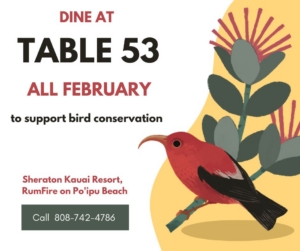
DINE FOR A CAUSE – ALL FEBRUARY LONG


🌿 Giving Tuesday: Two Ways to Support Kaua‘i’s Native Forest Birds
We’re excited to be a part of two Giving Tuesday fundraisers this year — North Shore Give Week and Give Big Hawai‘i — both supporting our mission to protect the last eight remaining native forest bird species on Kaua‘i. Your contributions power our most urgent conservation work, including mosquito control, predator management, and habitat protection in remote native forests.
Our forest birds are essential to the health of Kaua‘i’s watersheds, helping maintain the native forests that provide clean, reliable water for our communities. We are deeply grateful for your support in safeguarding their future.
Join us this Giving Tuesday and help keep Kaua‘i’s forest birds alive.


YOU ARE INVITED!
Kaua‘i Society of Artists Gallery | Kukui Grove Center
Exhibit Dates: November 8–14, 2025
Opening Hours: 11/8 – 10am-3pm, 11/9 -11/13 – 12-6pm, 11/14 12-3pm
Opening Reception: Friday, November 7 at 6 PM
Celebrate Hawai‘i’s manu through art! The Kaua‘i Forest Bird Recovery Project and Birds, Not Mosquitoes are teaming up with the Kaua‘i Endangered Seabird Recovery Project and Trees for Honolulu’s Future to showcase the beauty and importance of Hawai‘i’s native birds.
🌿 Special Events
Friday, Nov 7 | 6 PM – Opening Reception (FREE!) – SIGN UP HERE
Join us for refreshments, a blessing, and the first look at this year’s inspiring bird art.
Saturday, Nov 8 | 10 AM–3 PM
• 10 AM Kahili Pa‘a Lima Workshop with Kumu Kaeo – $100 – SIGN UP HERE
• Kaua‘i Cultural Artists Guild Vendors on site
Sunday, Nov 9 | 1 PM
• Ni‘ihau Shell Earring Workshop with Hi‘ipoi Kanahele – $100 – SIGN UP HERE
Monday, Nov 10 | 4–6 PM
• Seabird Art Class – Free – SIGN UP HERE
Tuesday, Nov 11 | 4 -6 PM
• Sip & Paint with Kumu Kehaulani – $55–$65 – SIGN UP HERE
Wednesday, Nov 12 | 4–6 PM
• Forest Journaling Workshop with Kim Rogers – Free – SIGN UP HERE
Friday, Nov 14 | Exhibit closes at 3 PM
(Art pickup begins at 3 PM)
🌈 Keiki Art Contest: “WeTrees!”
Keiki in grades K–8 are invited to create art celebrating the importance of trees — vital homes for many of Hawai‘i’s birds. Select Kaua‘i entries will be featured in the Wings & Woodlands Exhibit.
Email artcontest@treesforhonolulu.org
We are proud to launch our newest T-shirt campaign: E kū`ē i ka make loa – Resist Extinction. This shirt represents more than a conservation message—it embodies the coming together of cultural knowledge, artistic vision, and community action.
Language carries power, and it was important that this campaign reflect that. We partnered with Kumu Keahi Manea of the Ka Imi Naauao o Hawai`i Nei Institute, who consulted with Kumu Koki Williams to find the most resonant way to express “resist extinction” in Hawaiian.
Three possible phrases were shared:
E kū`ē i ka halapohe
E kū`ē i ka nalowale loa
E kū`ē i ka make loa
Together, we chose E kū`ē i ka make loa—“stand against the finality of extinction.”
The design itself comes from Hanah Cincotta, an artist whose work has brought the story of Kaua‘i’s birds to life. Hanah is best known for her award-winning cartoon about the Kaua‘i ʻōʻō, a haunting reminder of what has already been lost. For this campaign, her artwork weaves hope and resistance together—an image that speaks for the birds that still remain and calls us to action.
The shirt features ʻōhiʻa, the keystone tree species that every Hawaiian forest bird depends upon, symbolizing the deep interconnection between native plants and wildlife. It also highlights seven bird species: six that are still with us—‘akikiki, ‘anianiau, Kaua‘i ‘elepaio, ‘akeke‘e, puaiohi, and ‘i‘iwi—and one now lost, the Kaua‘i ʻōʻō. Together, they remind us of both the fragility of what remains and the resilience we must fight to uphold.
Kaua‘i’s native forest birds face critical threats from avian malaria carried by invasive mosquitoes, habitat loss, and climate change. Through conservation science, cultural grounding, and creative storytelling, KFBRP and our partners are working to give these species a fighting chance.
By wearing the E kū`ē i ka make loa – Resist Extinction shirt, you carry forward a message born of Hawaiian knowledge and expressed through art. Each shirt supports conservation and spreads awareness about the urgency of protecting our native birds.
🌿 Order your shirt here.
📸 Share your photos wearing it and tag us with #ResistExtinction to help grow the movement.
Together, we can resist extinction.
by Ke Coco Deng
5/30/2025
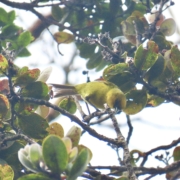
With the number of ‘akeke‘e steadily decreasing due to avian malaria, it is always exciting to see them in the wild. ‘Akeke‘e is a forest bird endemic to Kaua‘i. Even in their core habitat in the Alaka‘i Wilderness Preserve, ‘akeke‘e can be challenging to find as they forage high in the canopy on the buds of ʻōhiʻa. We treasure the time we spend living and working with them in the wild. One of our objectives this season is ‘akeke‘e nest searching: combing through miles of dense rainforest to find the nests of this increasingly elusive bird. Every nest is a valuable data point that grants us more knowledge about the life history of this critically endangered species.
To find an ‘akeke‘e nest, one must learn to think like an ‘akeke‘e. Nest searching requires a deep understanding of bird behavior. During the breeding season, ‘akeke‘e like to call and sing close to their nests to establish their territories. Our field technicians monitor ‘akeke‘e activity closely throughout the season, making note of when and where they are seen and heard so we can determine where they are likely to be nesting. This season, we have observed ‘akeke‘e singing, calling, and foraging over our Halepa‘akai field camp. Our crew have spent several weeks searching for nests in this area.
In April, field technician Ke Coco Deng discovered an ‘akeke‘e nest close to Halepa‘akai camp. She followed begging calls to a moss-lined nest with chicks, high up in the branches of an ʻōhiʻa lehua. All of our nests receive unique names to help us identify them. She named this nest “WARD,” as in protection, to lend good fortune to the nest and to the future of ‘akeke‘e. The name also refers to how we ward off threats to our forest birds through conservation so that they can continue to resist extinction. We made detailed observations about the chick rearing behavior of ‘akeke‘e at this nest, which may be important for future research and conservation.
A few weeks passed before our next nest update. We heard bird calls over Halepa‘akai camp and looked up to see an ‘akeke‘e family—two adults and two fledglings! The fledglings were making beginner attempts at foraging, slowly prying apart the buds of an ʻōhiʻa ha in search of insects. Though the bills of ‘akeke‘e have adapted to feed from insects inside ʻōhiʻa buds, practice makes perfect! Soon, the fledglings will be masters of foraging like their parents, finding insects in seconds. As ‘akeke‘e numbers continue to decline, it is heartening to see young birds joining the population. To help protect these vulnerable fledglings from mosquito-borne diseases like avian malaria, mosquito control efforts are currently being deployed on Kaua‘i. We hope to share the Alaka‘i with these birds for some time yet.
Blog Post by Abigail Bernier
This field season, much of the bird crew has been focused on collecting ʻanianiau eggs for the breeding conservation program, allowing us to have a population under human care for eventual release back into the wild. The forest birds face many threats currently, including avian malaria transmitted by invasive mosquitoes. We have been fortunate enough to be able to start work such as IIT, or incompatible insect technique, to reduce these mosquito populations. However, forest bird populations continue to decline even as mosquito control is being implemented.
Conservation Breeding Programs for ʻakikiki and ʻakekeʻe have already been established, laying the groundwork for other honeycreeper species. While the ʻanianiau population is still larger than the critically endangered ʻakikiki and ʻakekeʻe, our research shows that are declining significantly. ʻAnianiau are endemic to Kaua’i, meaning they are native to and only found on this island, and nowhere else in the world. To combat the risk of extinction, we have poured our resources into collecting clutches of ʻanianiau eggs that are sent to a specialized breeding facility, run by San Diego Zoo Wildlife Alliance (SDZWA), where teams of experienced scientists will hatch and raise the chicks. Meanwhile, last fall we collected a dozen adult ‘anianiau, most of which are at the Honolulu Zoo.
Before we can collect eggs, many hours of work go into finding and monitoring the nest. Following adults, watching mating behaviors, observing nest building, and peeping the nest (using an extendible pole with a GoPro attached for viewing) are just a few of the things that need to happen before a collection can be considered. The timing of a nest collection is also important for egg survival. The embryo is very fragile in the early days, but on the other hand, we don’t want to wait too long to avoid hatching during transport. Once determined that there are eggs and the nest is reachable, a free-standing ladder must be extended and set up using a rope to suspend it. The tree canopy and nest are very delicate, so we spend hours making sure we will not disturb the tree the nest is in and that the person collecting the eggs can do so safely. It takes a minimum of 6 people for this process and ample time to prepare the ladder for use. The ladder is extendable and when both pieces are connected weighs around 100 lbs. Even when the two portions are separated, it can be very difficult to carry the ladder for long distances through dense vegetation. If moving the ladder far, we often try to have a helicopter move the ladder attached to a longline. However, we are often in a closed canopy, so we still must carry the ladder to an area open enough to attach and sling the ladder closer to the nest location. The number of moving parts in a nest collection is astounding and requires great communication and teamwork from everyone.
On April 14, the first ʻanianiau nest was collected. The female had laid two small, white and speckled eggs, weighing about 1.5 grams each (half the weight of a penny). One of our aviculturists, specially trained in egg handling and collection, carefully climbed the ladder, high into the canopy. They then delicately reached into the nest to grasp each egg before putting it in a container filled with millet (to keep the eggs from moving around) and lowering it down to waiting arms at the bottom of the ladder. The eggs must be continuously incubated while in transport, so they are then placed into our portable incubator, powered by a battery and fitted in a cooler for insulation. Because this is a time-sensitive process and the portable incubator only has so much power, the eggs must be flown out of the field via helicopter at the earliest opportunity. Just after the eggs had reached the ground safely, they were hiked to the nearest spot a helicopter could land and transported with a team member. Timing the journey out of the field can be difficult, as weather conditions can change rapidly, and the helicopter pilots often only have a short window of time for our helicopter operation as part of their day. Typically, before being transported off-island to a SDZWA facility on Hawai’I Island, they will stay in our ‘egg-house’, where they receive 24/7 care in a proper incubator for a day or two. Luckily, these eggs were able to leave the island the same day for their new home.
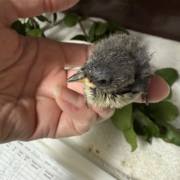
Several days later, one of the eggs hatched. It was an exciting moment for members of our team and forest bird lovers alike, the first ʻanianiau egg we had collected hatching in human care. It signaled a hopeful start to our collections, as we prepare for more soon. This truly would not have been possible without the hard work, dedication, and care of our team and SDZWA, as well as the love and support we have received from our community for the conservation of these forest birds. Unfortunately, the other egg did not hatch, as the embryo was later found not to be properly developed. This is sometimes the reality in nature; not every egg will survive. However, we are finding more ʻanianiau nests with eggs and hope to collect more in the coming weeks. We will be contributing further to the captive population, which will act as an insurance policy if this population were to decline beyond the ability to recover naturally.
Mahalo for your support and sharing in our hope for the ʻanianiau. You can continue to follow the journey of our nest collections and the chick on our social media, as well as follow along on our blog for updates and news.
ALAKAʻI PLATEAU, Kauaʻi – It seems counterintuitive to release hundreds of thousands of mosquitoes into an area where the insects are spreading avian malaria and bringing several species of Hawaiian honeycreepers to the precipice of extinction.
Nonetheless, staff from the Kaua‘i Forest Bird Recovery Project (KFBRP) heralded Thursday’s first release of male mosquitoes, into a state forest reserve on the vast Alakaʻi Plateau, as momentous.
Ten years of planning, permitting and community outreach led the team and its partners, to the release of male mosquitoes that are reproductively incompatible with female mosquitoes, which bite and spread the often-deadly disease.
“Incompatible Insect Technology, or IIT, leads to mosquito population suppression, and we hope it will reduce the amount of avian malaria which is driving the declines of native forest birds,” explained Dr. Lisa ‘Cali’ Crampton, the head of KFBRP.
IIT has been deployed successfully around the world. This is the first time it’s been used on Kaua‘i as a biological control to try and severely reduce the number of malaria-carrying mosquitoes. “It is a tried and true and safe technique that has been used hundreds of times,” Crampton said.
The mosquitoes are flown from a facility in California and each week, half a million bugs will be loaded onto a helicopter in biodegradable cones that resemble an ice cream sugar cone.
The deployment helicopters are outfitted with a specially designed tube which directs each cone out of the bottom of the aircraft, where they float to the ground. “We do this twice a week to ensure there’s a very, very high likelihood that a wild female will encounter one of the incompatible males. We’re really trying to interrupt the reproductive cycle,” explained Crampton.
She says she is very hopeful, a sentiment shared by DLNR Division of Forestry and Wildlife planner Justin Hite. He spent a decade leading KFBRP field teams into the remote areas favored by species like the ‘akikiki and the ‘akeke’e, two of the honeycreepers with such low numbers they’re likely to completely disappear from the wilds in the next year or two.
Hite observed yesterday’s releases and said, “We hope this really moves the needle for these species.”
The bird recovery teams are employing what Crampton calls, “integrated pest management.” In addition to the IIT releases, they’re using a common larvicide known as BTi, which targets one phase of the mosquito life cycle – the larval phase. It’s been used on the ground on the Alakaʻi for nine years, and over the past year it’s also been applied from helicopters. IIT targets the adult stage and the egg production stage. “So, the idea is the BTi reduces populations of adult mosquitoes to begin with, making it more likely that females will encounter one of these incompatible males,” according to Crampton.
The insurance they have for the continued existence of the most critically endangered birds, are conservation breeding populations. Crampton said that once IIT and BTi have been used for a year or so over the best forest bird habitat on Kaua‘i, they remain hopeful birds in the conservation programs, or their offspring will one day be released back into the wild.
# # #
RESOURCES
(All images/video Courtesy: DLNR)
HD video – Releasing Mosquitoes to Help Kaua‘i’s Forest Birds (web feature):
HD video – First IIT releases on Kaua‘i media clips (Feb. 13, 2025):
Photographs – First IIT releases on Kaua‘i (Feb. 13, 2025):
Media Contact:
Dan Dennison
Communications Director
Hawai‘i Dept. of Land and Natural Resources
BLESSING THE “BIRDS” CRITICAL TO SAVING KAUA‘I’S FOREST BIRDS
Annual Field Season Blessing Recognizes the Importance of Helicopters
FOR IMMEDIATE RELEASE
Feb. 4, 2024
LĪHUʻE, Kaua‘i — In a hangar on the north end of the Līhuʻe International Airport, more than two dozen people gathered on Monday to bless the beginning of another field season
Typically, the annual blessings are conducted at Kōkeʻe, near the Alaka‘i Plateau where, for nearly 20 years, staff from the Kaua‘i Forest Bird Recovery Project (KFBRP) have worked to save the island’s native forest birds from extinction.
Dr. Lisa ‘Cali’ Crampton leads KFBRP and says she has a real-world vision of how critical helicopters are to the mission.
“When we started doing all the work we do in the Alaka‘i the only air support we had was to get our food and our really heavy supplies in and out of the Alaka‘i and we did all the rest of the things we needed to do on foot,” Crampton said.
That involved commuting on foot over arduous terrain. Crampton says that took a major toll on workers and it reduced the time they spent in the field working with birds. She added, “Working with our partners to find the budget that we needed to be able to increase the amount of air support we have for our operations has been critical.”
Justin Hite, formerly with KFBRP, but now working as a planner with the DLNR Division of Forestry and Wildlife (DOFAW), echoed Crampton’s comments. “Physically, just getting to the different spots where the work’s going to take place is a two-hour drive, plus a seven-hour hike. To do the work in a productive way you’ve got to have air support,” Hite explained.
The helicopters will be especially indispensable this field season for a two-pronged mosquito control effort in Kaua‘i’s mountains, where forest bird populations have been decimated by the advance of avian malaria from lower elevations due to global warming.
Beginning next week, helicopters will begin dropping cones full of male mosquitoes that are incompatible with local females so their matings are inviable, thus reducing their population. For the past year teams have also used choppers to spread a biological larvicide, which is targeted bacteria to eliminate mosquito larvae in standing water.
“In the past we’ve tried to reduce populations with hand treatments and it’s like finding a needle in a haystack trying to find every little water source there is in the Alaka‘i Plateau because essentially it’s a swamp,” Crampton said.
Thirdly this season, helicopters will serve as a kind of intensive neo-natal care transport for the eggs of ‘anianiau as the team begins a conservation breeding program for the species to serve as an insurance population. “If we can’t get those eggs out in a timely fashion by helicopter, the program won’t work because it’s too dangerous and too time consuming to hike tiny little eggs out, Crampton explained
Hite and his 18-month-old daughter watched members of Ka ʻImi Naʻauao O Hawaiʻi Nei Institute perform ‘oli and chants to bless the upcoming field season. He said his daughter loves helicopters. “As soon as we pulled up here to the airport there were about five or six flying at once and she was spinning in all directions. She doesn’t call them helicopters yet. I think she calls all flying birds and other flying things nēnē,” Hite joked.
Staff from Jack Harter Helicopters joined the blessing. “It’s just been a great teamwork kind of thing. We just appreciate having you guys around, because you may know it or not, but Jack Harter died a few years ago,” said the company’s special projects director Casey Riemer.
“The first time I went flying with him, he talked about the birds in his narration. Talked about how they’re worried about the temperature rising high and the mosquitoes getting up there. So, now we’re doing something to help keep it from going further,” he added.
The company’s website even includes a tab where customers can donate to the cause. Full circle indeed.
# # #
RESOURCES
(All images/video courtesy: DLNR)
HD video – Birds for Birds-Blessing Kaua‘i Forest Bird Field Season (web feature)
HD video – Kaua‘i forest bird field season blessing (Feb. 3, 2025):
(Shot sheet/transcription attached)
Photographs – Kaua‘i forest bird field season blessing (Feb. 3, 2025):
Learn more:
https://dlnr.hawaii.gov/wildlife/birds/
Media Contact:
Dan Dennison
Communications Director
Hawai‘i Dept. of Land and Natural Resources
808-587-0396
Email: Dlnr.comms@hawaii.gov